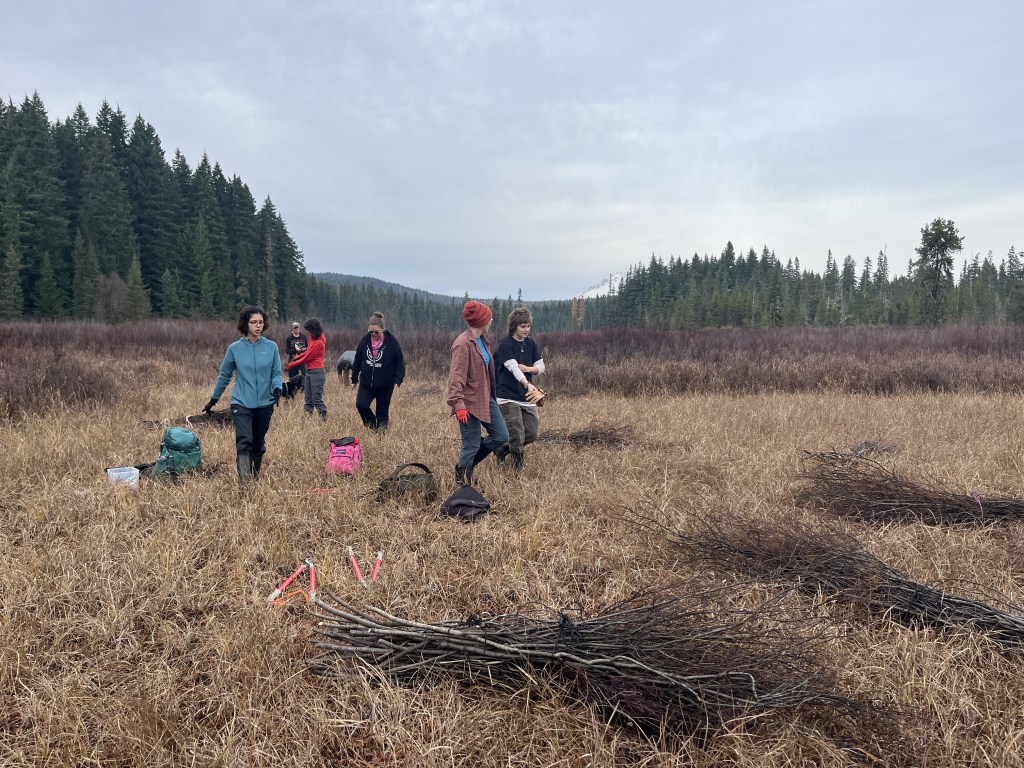
Beaver and willow go together like peanut butter and jelly, which as it turns out, is often my lunch when out on field days with Bark in Mount Hood National Forest. Two of those days recently involved harvesting willow in one area of the forest and then transplanting it to another. Like building beaver dam analogs, the goal is create ideal beaver habitat in the hopes that a family will move in and work their ecosystem engineering magic. Whereas beaver dam analogs aim to provide standing water for cover and safety, willow planting provides food and building material.
Beaver and willow have engaged in a tight reciprocal dance for millions of years, each shaping the other and creating a dynamic duo of ecosystem engineering. Willow is well-adapted to heavy browsing by beavers and other animals like deer and elk. It responds to cutting by growing back more vigorously and creating the dense shrubby hedgerows often seen along the edges of wetlands. When beavers cut willow to feed and build dams, this creates the wet conditions that willow loves. The interaction often follows a classic predator-prey cycle where the beavers will eventually eat all the willow and move on, leaving behind a wet, nutrient rich ecosystem well adapted to willow where it can re-establish and start the cycle all over again. That last part of the cycle, willow re-establishment, is the step we are trying to speed up with this project.
Harvest
The plan was to complete this project in two phases. A mid-week harvesting day with a small group of volunteers, and then a weekend planting day with a bigger group. The harvest crew met up on a crisp, but dry Thursday morning at the Gateway Transit Center in Portland. After brief introductions, we arranged carpools, and then set off for the 90 minute drive up to our site. There were seven of us altogether, a decent showing for a weekday. I rode up with a very recent new arrival from Colorado and was happy to gush about the grandeur of all that is within an hour and a half of Portland from coast to rain forest to high desert. I am an introvert by nature and so I always have some pangs of anxiety about a situation like this; jumping in a car with someone I don’t know at all and being stuck with them for an hour and a half. In every case on these Bark outings though, that anxiety quickly vanishes into curiosity and conversation. It’s a self-selecting group, forest nerds and beaver geeks, so odds are high there will be plenty in common and plenty to talk about.
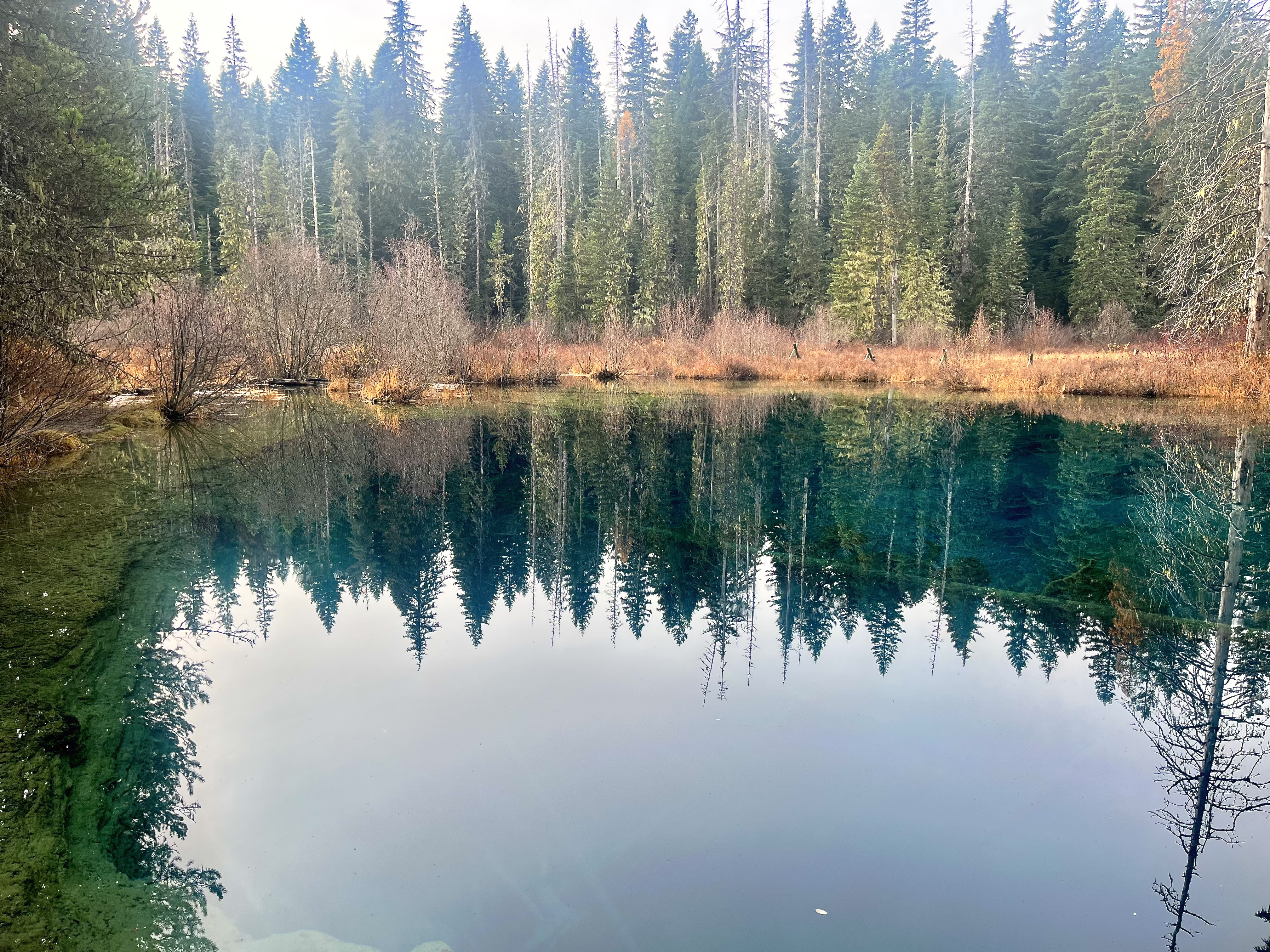
Our harvest site was near Little Crater Lake, an interesting geologic oddity a few miles South of Timothy Lake. It’s a 40 foot deep artesian spring fed pond with crystal clear water that is a striking deep blue color. We found some very recent beaver sign around the lake in the form of some chewed alder. This was unexpected, but always a welcome sight.
A quick one mile hike on flat ground got us to the harvest site where Meg, the Restoration Coordinator at Bark, gave us a crash course in Willow identification before sending us off into the brush with pruners and loppers. It’s a little more difficult this time of year to identify plants since there aren’t too many leaves left, but it’s necessary to harvest and plant in the fall when they are dormant to maximize chances of survival. Luckily there’s still plenty of telltale characteristics for willow including yellowish bark at the tips, no cone-like catkins (that would be alder), no deep red bark (that would be red osier dogwood), and if there are leaves, they will be smooth and elongated.
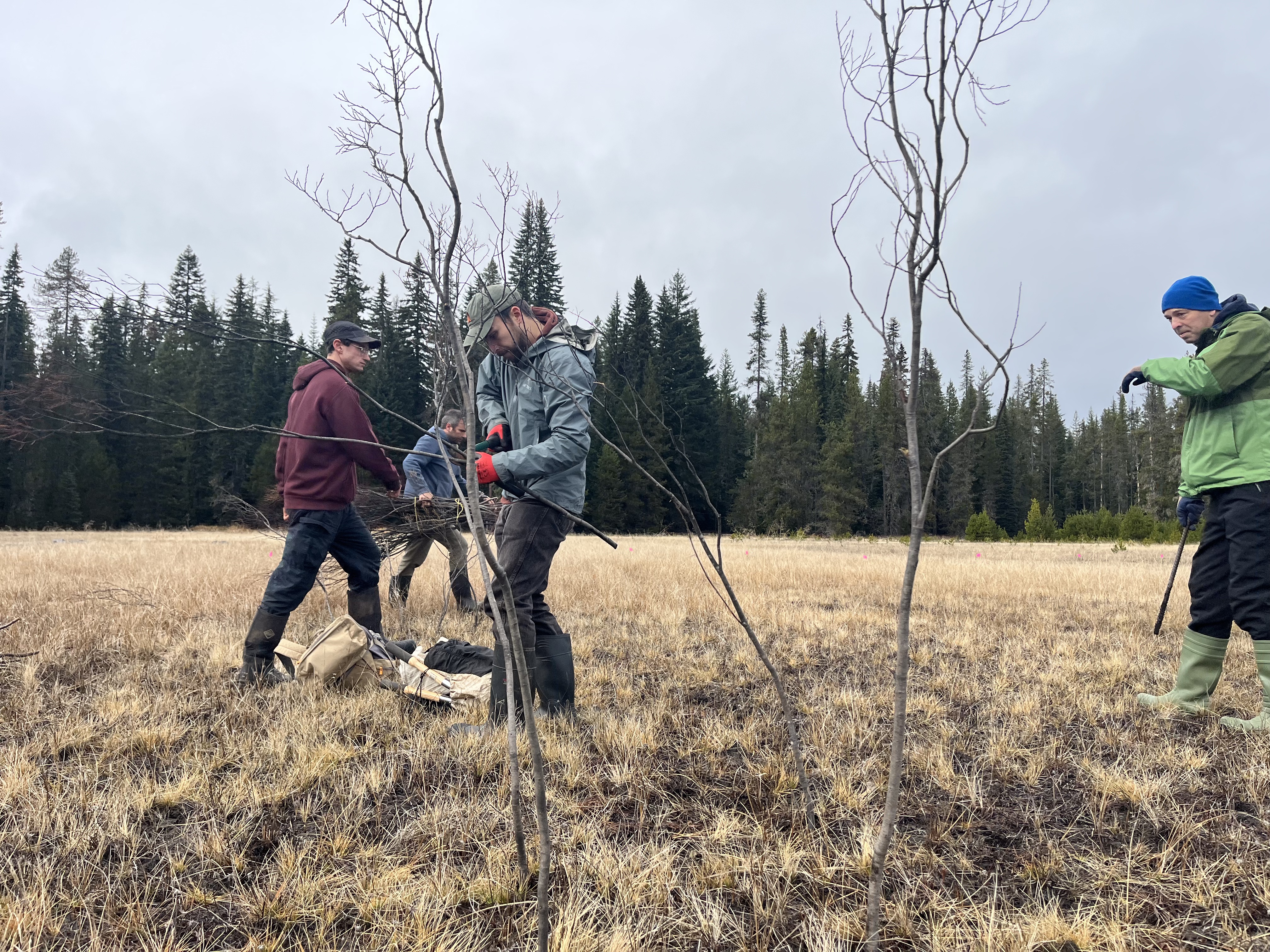
We spent the next couple of hours working in pairs, one cutter and one bundler, gathering the slender twigs. We weren’t digging, just taking cuttings. Willow is so robust and prolific, that all you need to do is cut a branch and stick it in the ground to start a new plant. It was a perfect day, filtered sunshine, some thin clouds, warm enough to be in a t-shirt but not so warm I worked up a sweat. The kind of days that are getting fewer and farther between as we slip into the winter. I worked with a couple of different people throughout the day; a PSU Anthropology senior who told me about growing up on Kodiak island among giant bears and working her family’s fishing camp; and a well-traveled nurse who filled my ears with tales of exotic Mongolian ferments and horse treks. Beaver work attracts the most interesting people.
Once we were done, we tied up the twigs in bundles and headed back to the cars, a bundle under each arm. Even though it was only a mile or so, it was a much longer trip out than in. These were not small bundles. Arms burning, I was happier than I normally would be to see the parking lot. We stuffed 16 bundles of willow into a minivan, and it did take stuffing, as well as some trimming, and also some pulling and grunting. The harvest complete, we loaded up and headed back to Portland.
Planting
Planting day was a much more typical Western Oregon late fall/early winter day—cool and wet. We met once again at the Gateway Transit Center, but this time a much larger group, 25 or so altogether. Twenty-five people, on a Sunday, in the rain, showing up to go poke sticks in the ground so a large rodent will have some food.
Arriving at the planting site, we piled out of the cars and donned rubber boots and rain gear. We carefully dislodged the willow bundles from the minivan interior that we’d spent so much effort stuffing in a few days prior. We gathered tools and willow bundles and walked to the planting site.
The site was a multi-acre clearing in the surrounding conifer forest. A small stream, not much more than at trickle, ran down the center. Sphagnum moss and young Lodgepole Pine ringed the edges. Our planting area was a strip of muddy ground between the stream and the mossy margin.
We again worked in teams. One person used a piece of rebar to punch a hole and the other dropped a willow branch into it. With 25+ people, the work went fast and we planted an estimated 400-500 plants in about an hour. Clusters of leafless twigs popped up throughout the meadow as we worked creating little shrubs that looked like they had always been there.
We finished planting the pre-harvested willow so quickly that we still had plenty of time left in the day. There was another site nearby where we could harvest some more willow and we all hiked there, loppers in hand. We harvested as much willow as we had just planted and then schlepped it all back to the original site. Planting again went quickly, and 500 more twigs popped out of the ground in less than an hour. It was estimated that we planted close to 1,000 willows altogether that day. Hopefully these will take hold, entice a beaver family to move in and transform this meadow into a thriving wetland that is more fire resistant and provides clean water for fish and myriad other species including humans downstream.
This was Bark’s final field day for the season and I’m glad I could make it out to help with the project. We will be heading to Baja for 3 months in a couple of weeks and this was the perfect way to wrap up Fall here in Oregon by giving back to one of my favorite places and doing it with some great people.


Leave a Reply