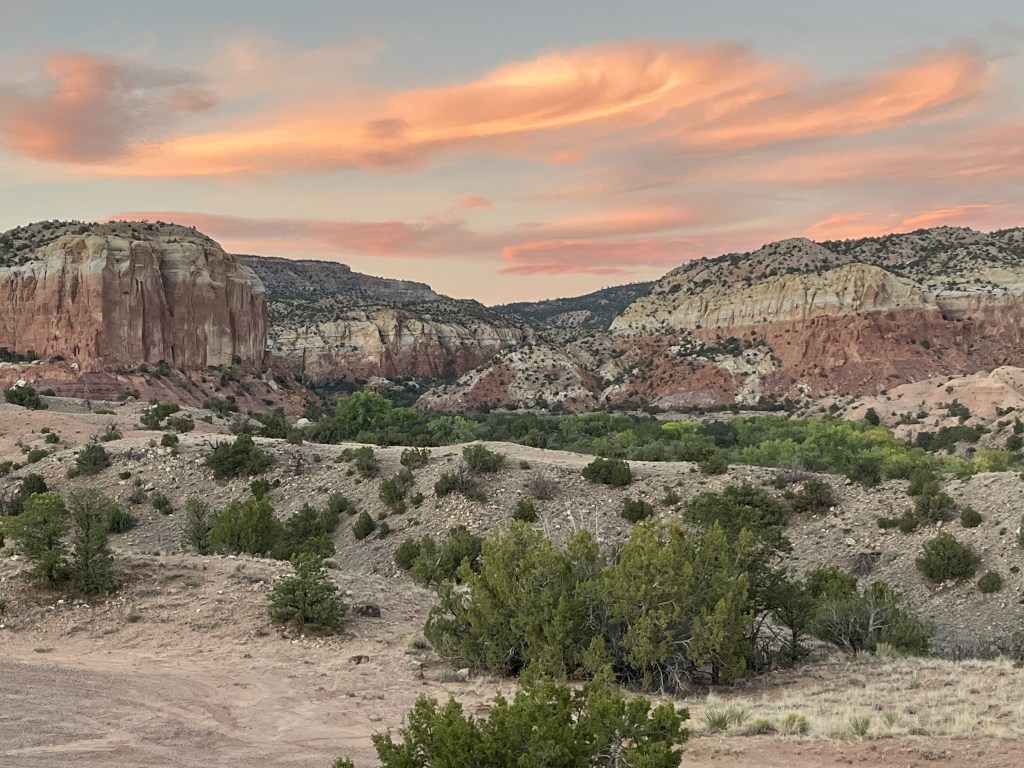
I had just returned from a day of hiking around Ghost Ranch in New Mexico and was meeting friends at the dining hall there for dinner. My walk had taken me along the cottonwood bosque running north from the ranch, alive with trickling water and chittering birds, the multi-hued rock formations, jagged and rippling that had inspired so many artists over the years, rising in the distance. A class 3 scramble up a tight chimney had put me out on top of Kitchen Mesa looking down on the ranch and the blue waters of Abiquiú Reservoir. There was a nap under a juniper in there before I headed back down and ended up there at the dining hall. Outside the main doors is a bulletin board where guests are encouraged to share quotes, snippets of poetry, thoughts, or jokes. I came across one that seemed to be put there just for me. It read:
If one wanders all day and reaches evening, it is enough.
The quote was attributed to Petrarch, the 14th century Italian scholar and progenitor of the Italian Renaissance and Humanism. He traveled widely in Medieval Europe and is sometimes called “the first tourist.” No wonder he thought so highly of the virtues of wandering.
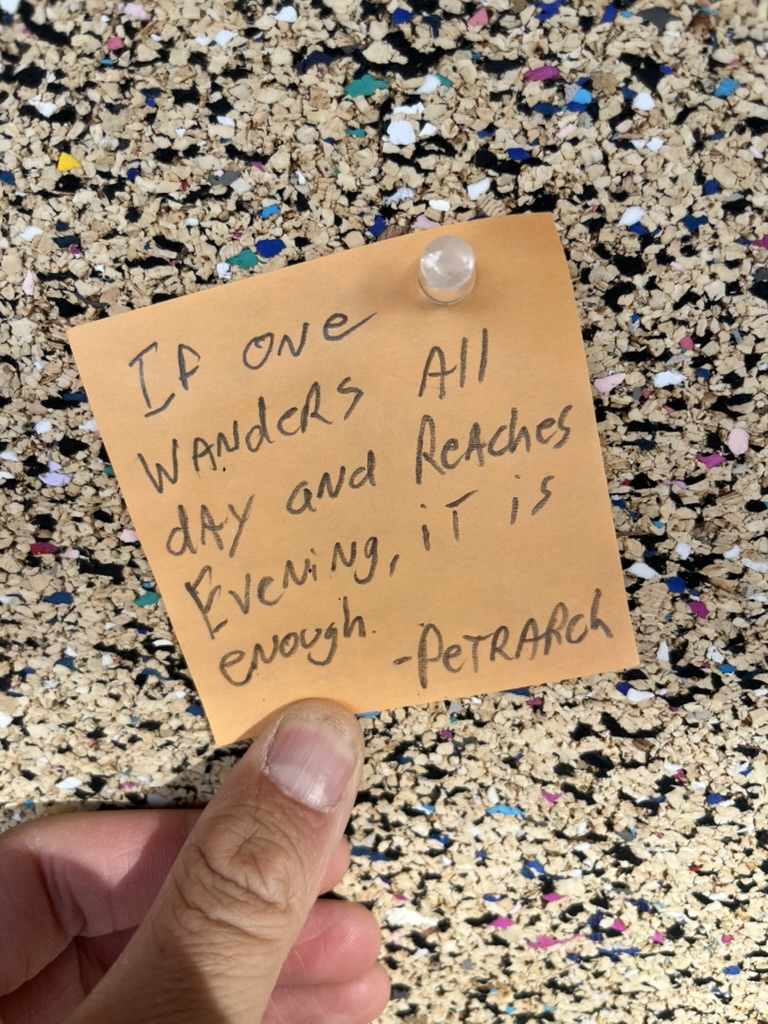
The quote spoke to me on the surface because I had in fact been wandering all day and had reached evening so I could relate to it directly in that respect. However, it was the main clause that really caught my attention — “it is enough”.
The concept of “enough” is something I’ve been thinking about a lot this year as I navigate the transition from leaving my tech career into what comes next. As I’ve touched on in other posts, identifying what enough looks like in terms of material possessions and money is a key step in being able to step off the treadmill of earning and consuming to reclaim one’s time and gain the freedom to pursue what really matters. However, this quote from Petrarch got to a different aspect of “enough”.
The crux of the issue is that our culture places so much emphasis on productivity and ties that to self-worth and status. It’s a very narrow view of productivity also — one based on perceived economic value and raw output. The measure of that, of course, is how much money one can trade their time for. Alongside the accumulation of money comes the accumulation of stuff. Following this to its logical conclusion then, conspicuous consumption is the outward sign of one’s productivity.
My hike that day was incidental to the whole reason we were at Ghost Ranch to begin with. We were there for my wife to attend a workshop with author Robin Wall Kimmerer. Kimmerer has a lot to say about “enoughness” and how it can be an antidote to the psychological, spiritual, and ecological crises of our time. In her book, The Serviceberry: Abundance and Reciprocity in the Natural World, Kimmerer says, “Recognizing “enoughness” is a radical act in an economy that is always urging us to consume more.” She takes this a step further in the idea of a gift economy. An economy where wealth is understood as having enough to share. In such an economy, wealth and status are measured in terms of what one can give, not what one can accumulate. Abundance is understood as everyone having enough, not necessarily maximum output.
While useful in reframing economic thinking and the meaning of wealth and abundance, this is still a primarily material take. How can productivity be thought of in a more expansive way, beyond material output? How can spending the day wandering on the creekside and in the hills be productive? How can it be enough?
In her poem, The Summer Day, Mary Oliver famously asks, “What is it you plan to do with your one wild and precious life?” If I’m being honest, that line can stress me out a little bit if taken alone. It gets to part of my anxiety during this transition. I wonder if I’m wasting precious time. If I’m not doing monumental things with this freedom, am I squandering it? What exactly am I doing with my one wild and precious life? Taken out of context, that line can indeed be anxiety producing. However, reading the preceding lines a more nuanced take comes through. She writes:
I don’t know exactly what a prayer is.
I do know how to pay attention, how to fall down
into the grass, how to kneel down in the grass,
how to be idle and blessed, how to stroll through the fields,
which is what I have been doing all day.
Tell me, what else should I have done?
Doesn’t everything die at last, and too soon?
Like Petrarch and me, Oliver has been strolling through the fields all day. She finds purpose and value in paying attention, in being present in her life, even in seemingly small things like kneeling in the grass or walking in the fields. These things are enough, they are a worthy way to spend one’s wild and precious life — kneeling in the grass, watching a grasshopper. There is even a snarkiness to her tone, challenging anyone to tell her what else she should have done. She doesn’t need to account for how she spent her day to anyone. Indeed, it is an accomplishment in our frenetic world of screens and sparkly objects to simply be present in one’s own life; to take in the wonders of the natural world that is all around us and is our birthright, but that we so often let fade into the background; to care for our bodies, our spirits, our relationships, and for the earth.
Much of my time this year has been spent doing things that don’t make money and therefore aren’t viewed as productive in our usual accounting. Things like taking care of my health with exercise and cooking healthy meals for myself and my partner, habitat restoration and forest defense work, house maintenance and repair, gardening, foraging, and food preservation, nurturing relationships with friends and family through service and reciprocal exchange, and yes, plenty of wandering in the fields, woods, and mountains. If I take as much inspiration as I’d like to from Mary Oliver, I wouldn’t feel the need to create the preceding list of supposedly productive pursuits. I’d be comfortable in the fact that my days spent wandering in the mountains, being present, paying attention, were enough.
But I still need to know I’m not wasting my time. Not to account to anyone else, but to account to myself. I need a way to measure and evaluate how I’m spending my time, even if it’s not the ways I’ve been used to throughout the rest of my life. I just need a different yardstick. One that values the health of my own body and of the earth, relationships with people and the natural world, care and maintenance, attention. I want to be productive, but not necessarily in the way we usually think about it. I’m not against productivity, I just want to expand the meaning beyond how we usually think about and measure it. This is the fundamental shift in my own mind and the shift that I’d ultimately like to see our broader culture make as well. More emphasis on care, creation, attention, and health. Less on consumption, accumulation, and performing for the highlight reel.
That day spent wandering in the New Mexico desert climbing mesas and napping under junipers, put me in good company with the likes of Mary Oliver and Petrarch. People who have found enough in simply paying attention. The more time I spend wandering in the hills (and by extension off the screens), being present to the wonders large and small all around me out there, the more I’m expanding my notion of success, wealth, and productivity. Attention, presence, connection to the deeper parts of myself and this big, beautiful world of ours. If I manage to be present for it all, to savor it, to examine it deeply, that is enough; a fine way to spend my one wild and precious life.


Leave a Reply