Author: tom

  • A Day Hiking the Stunning Windows Trail in Big Bend

    A Day Hiking the Stunning Windows Trail in Big Bend

    The relentless desert heat drove us back to the Chisos Mountains, where we decided to tackle the Windows Trail – one of Big Bend’s must-see hikes. At the visitor center, we encountered what would turn out to be the first character in our day’s story: a volunteer guarding the trailhead and ensuring everyone had enough water. We watched as he turned away the hikers ahead of us for insufficient water supplies. When our turn came, we presented our three liters, earning a skeptical “That’s probably not enough” (spoiler: it was fine) along with warnings about the steep climb and promises of shade and water at a campground on the return should we need it.

    The trail revealed itself gradually, dropping through classic Chisos terrain. Mountains rose around us while a narrow notch in the peaks framed the desert plains below like a natural window. Though we descended quite a ways, the trail’s mild switchbacks made for comfortable hiking. A couple miles in, the landscape transformed as we entered a steep canyon filled with oak groves, Mexican Buckeye, and Texas Lignum in bloom – a welcome respite from the exposed desert.

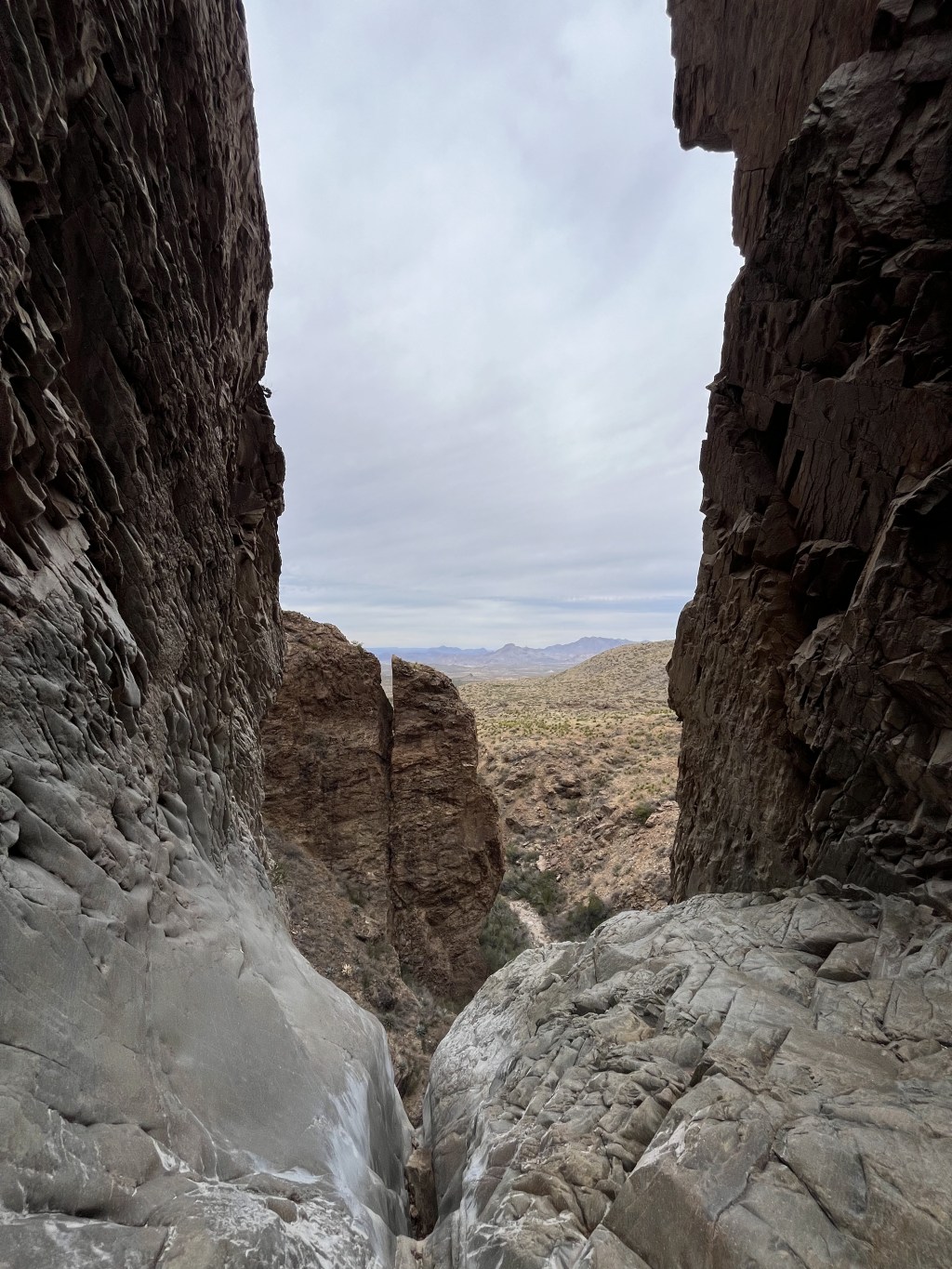
    The path eventually narrowed into a wash where someone had carefully built steps for the tricky spots. At the end waited another pour-off, this one plunging about 200 feet. The slick rock approach got our attention, but solid ledges made it safe to take in the view. I loved watching the mix of people here – a woman who didn’t look like a regular hiker but was clearly enjoying herself, a family whose kids bounded around while their mom insisted on the “four points of contact” rule they’d apparently learned at Arches.

    We found a quiet side trail on the return that led to a western viewpoint of the desert floor – the perfect lunch spot away from the crowds. The climb back wasn’t nearly as daunting as warned, and we had plenty of water despite the early warnings. We celebrated at the visitor’s center with ice cream sandwiches, where I struck up a conversation with a fellow Oregonian from Newport. He showed me around his Four Wheel Camper while we talked about the state of Portland.

    On the way back to camp, we stopped at Dugout Wells where an ancient windmill still pumped water to a green oasis in the desert. We met a local sipping a Modelo in the shade. He was from Oklahoma and owned some land near Terlingua . His tales of the area convinced us to try both the hot springs and the Boquillas border crossing. He told us about bringing supplies to kids in the Mexican village just across the river and how the whole place runs on solar power.

    We ended our day at the hot springs, where the remains of an old resort and its palm trees hint at its past life. The site sits right on the Rio Grande, where old bathhouse walls still catch hot water before it joins the river. With the air hitting 95 degrees, we started with a cooling river dip. I loved the mix of people here too – families splashing alongside tattooed hipsters, everyone finding common ground in the healing waters. Though the spring was barely warmer than the air, it felt surprisingly good. As we bounced back up the rough road to camp, where we made dinner, enjoyed another spectacular sunset, and settled in for our work week.

  • To Big Bend

    To Big Bend

    We left Carlsbad near sunrise, which was around 7 am in the Mountain timezone of New Mexico, but 8 am directly South about an hour’s drive away in Texas, which is in Central timezone. A quirk of the artificial boundaries we like to place on space and time. Our destination was a Hipcamp we had reserved just outside of Big Bend National Park.

    We retraced our steps from the previous day past White’s City and Guadalupe Mountains National Park, continuing through the seemingly endless, flat, Permian wastelands. Eventually it did end though, and the landscape started getting a little bumpier, a rolling hill there, a mesa there. Road signs informed us we were on the “Texas Mountain Trail”, although to our North-westerner eyes used to the Cascades and the Rockies it seemed more like the “Texas Hill Trail”.

    Our first stop in Texas was in a little town called Van Horn. We pulled into a gas station for a bathroom break and snacks. As I was perusing the drink cooler, I overheard two men in conversation, both of course in the uniform of these parts, cowboy hat, Wranglers, and boots. The way they spoke was the most interesting part though, fluidly switching between English and Spanish, sometimes mid-sentence. Sometimes one would ask a question in English and the other would answer in Spanish. A testament to the unique blend of cultures here.

    Our next stop was the town of Marfa, known as a quirky artists’ redoubt in the hardscrabble landscape of West Texas. Our main reason for stopping here was to visit the Chinatti museum, an old army base turned into a sprawling gallery and workspaces for resident artists. The main permanent exhibits are collections of huge sculptures by the artist Donald Judd. The first collection fills two massive “artillery sheds”. Each one is filled with boxes made from milled aluminum with the space inside broken up in different ways. The shed walls are all glass letting in sunlight that bounces off of the shiny metal at odd angles. Outside are similar sculptures. Huge boxes made of concrete instead of aluminum. After a stop at the post office to send some post cards, and then the grocery, we were on our way toward Big Bend.

    As we continued South, the landscape started to get more mountainous, punctuated by mesas and canyons. Verdant from recent rains with dark clouds along the edges threatening more. At some point we lost cell reception and it didn’t come back.

    We arrived at our Hipcamp called Coyote Crossing in the early evening. We turned off the main road just before the tiny town of Study Butte to a ramshackle collection of small buildings; a small house, a shed, a carport. We arrived just as the proprietor was getting home as well. He crawled out of his truck and greeted us, grocery bag and a 12 pack under his arm. A big man in a stained t-shirt, he proceeded to tell us how he’d arrived in these parts, canoeing down the Mississippi to the Gulf of Mexico, and then up the Rio Grande, getting a job as a river guide and never leaving. He also told us about the Spring Break hordes that had descended on the place a couple weeks prior and how he was quietly amused when their tents were sent airborne by the relentless desert wind. He sent us down into his 20 acre patch of dirt to find a spot to post up for the night. We selected a spot and made some dinner which we ate while watching a spectacular sunset.

    Over night we learned why the place was called Coyote Crossing when we were awakened by howling coyotes a few feet from the camper. Despite that, we slept well and were up early to head into Big Bend National Park. After filling up on gas and coffee in Study Butte, we headed for the entrance. We were planning on staying in the park for the work week so our first order of business was to secure one on of the “primitive roadside camping” permits. These campsites are located along remote desert roads within the park and are generally only accessible by high-clearance, and often 4×4 vehicles. There are 54 of these sites altogether. Some can be reserved online while others are only available on a first-come-first-serve basis at the visitor’s center.

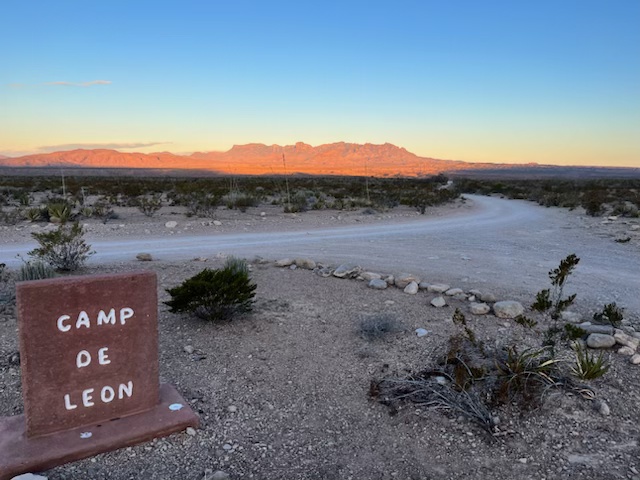
    We were definitely a little nervous that we wouldn’t be able to get a site so we were relieved when we arrived at the Panther Junction Visitor’s Center and there wasn’t a long line of people clamoring for a site. We were able to talk to a ranger almost immediately on arrival. She was incredibly friendly and helpful walking us through the available sites, showing us pictures of them, and discussing the pros and cons of each. We settled on “Camp De Leon” off of Old Ore Road on the Eastern side of the park. With our site secured for the week we headed out for our first hike of the day.

    The hike we chose for our first one in Big Gend was the “Burro Mesa Pouroff” trail. The hike started in typical scrublands, but quickly descended into a canyon. Even in the morning, the temperature was already quickly rising. The day would top out in the upper 90s. As we continued in the canyon, we heard the distinctive descending melody of Canyon Wren song and the vegetation got more lush. We came to a rock feature called a “window”, a full rock arch in a circular shape about 30 feet up from the canyon floor. A bit further, we found a beautiful pink flower growing out of cracks in the canyon wall called Cedar Sage. The smell was divine, like a sweet, minty sage. It would have been great to spice up our dinner later, but I resisted the urge to pluck a leaf as there wasn’t much of it.

    The Pouroff itself came after a short vertical scramble which opened up to a wide chamber in the canyon. A Pouroff is to a waterfall what a wash is to a creek, that is, a waterfall without water. Looking over the edge, you can imagine water rushing through here and careening over, dropping a hundred or so feet. A narrow slit was created in the canyon wall where the blue sky and landscape beyond were visible.

    Next, we headed toward Santa Elena Canyon in the Southwestern corner of the park. We stopped at a viewpoint where we got our first look at the Rio Grande canyon and into Mexico. It isn’t the Grand Canyon, but it is still deep, wide, and impressive. Our original plan was to walk the trail up Santa Elena Canyon, but the parking lot was overflowing, which meant the short half mile trail was probably elbow to elbow. We decided it wasn’t worth the hassle of parking and combat hiking, so we turned around and headed back to a much less crowded picnic area we had seen by the river. We ate some lunch under a shade structure and then walked down for our first up close and personal contact with the mighty Rio Grande. It actually wasn’t that mighty. About ankle deep in the middle and perhaps 20 feet across. More like what we would call a creek back home. Still, it’s the lifeblood of this whole region and the lush riparian zone on it’s edges is a welcome respite from the scorching desert.

    As afternoon approached, the temperatures started to climb into the upper 90s so we decided to spend the afternoon in the air conditioned comfort of the truck cab exploring some of the park’s backcountry roads . We drove up the Old Maverick Road from the canyon bottom back toward the park entrance. There were scary signs at the start warning that it was suitable for high clearance 4×4 vehicles only. It was rough in spots and a few wash crossing where some extra clearance was nice, but not too bad relatively speaking. We passed by a small adobe cabin called a Jacal that was slowly being swallowed by the desert. A nearby sign said it was built by a man named Luna who lived there until he was 108 years old! He raised a family there and farmed the area using water diverted from the river.

    From there we drove up into the Chisos Mountains where we suspected it would also be cooler. The mountains are a 20 mile range totally contained within the park. With peaks rising to 7,500 feet or more, they offer a totally different climate, ecology, and scenery from the surrounding desert. The temperatures were a good 10 degrees cooler and the vegetation was much more varied with oak, pine, and juniper dominating. We stopped in at the Chisos Visitor’s Center where we filled our water bottles and indulged in ice cream sandwiches, a real treat on a hot day.

    We drove back down out of the Chisos and over to the East Side of the park toward our campsite. The rangers were not kidding when they told us the road was rough. After about 30 minutes of bouncing down the road we arrived at our site. It was a wonderful site with no one around and a great view of the mountains to the North. It would be a great place to spend the work week.

  • New Mexico National Parks

    New Mexico National Parks

    We stayed another cold, windy night outside of Las Cruces, New Mexico at the Preshistoric Trackways National Monument and so the day started out with a short hike there. This monument is quite different from others we’ve visited. It isn’t made up of stunning vistas or untouched wilderness. Rather, it’s only a few miles from downtown Las Cruces and it actually borders a working gravel pit. What makes this place special though is that it contains a high density of fossilized animal tracks, petrified wood, even fossilized raindrops from millions of years ago. As the BLM describes it, “The site contains one of the most scientifically-significant Early Permian track sites in the world.” Even our untrained eyes could pick out shell fossils and petrified wood as we walked along the trail.

    Our next stop of the day was White Sands National Park about an hour from Las Cruces. This park is exactly as the name implies, 275 square miles of brilliant white gypsum sand dunes. As the tagline says, it really is like nowhere else on earth. We opted for the 5 mile “Alkali Flats” loop hike. As the sign at the start of the hike emphasizes, the hike is not flat. It’s walking up and down large dunes in loose sand, which as a result, makes it feel like much longer than five miles. The park is also close to several Air Force bases and missile testing facilities, as well as being where the first atomic bomb was tested. The park is sometimes closed due to missile testing and there were signs warning not to pick anything up that you might find as it could be unexploded munitions, yikes. All in all, it’s a unique place, beautiful in it’s own way and worth a visit.

    After White Sands, we started up and over the Southern Rocky Mountains. The high desert of Eastern New Mexico gave way to mountain forests of Pine and Juniper and precious, clear, flowing water. Snow was still lingering as we went through the small town of Cloudcroft at around 8,500 feet. The road drops down the Eastern side and into the desolate flats of the Permian Basin. I can usually find some kind of beauty in most landscapes, even seemingly desolate and barren ones, but I have to say Eastern New Mexico and West Texas are tough. A flat, brown, windy, dusty landscape punctuated by oil rigs and dominated by scrubby Creosote. It would be a tough place to live and I have to admire the folks who man those rigs and scratch out crops from the dusty soil. We stayed the night in Carlsbad, New Mexico at a place called the Post Time Inn. It was time for us to do laundry and this place offered an affordable and comfortable room with free laundry facilities.

    A word on our clothing choices for this trip. We planned to be close enough to civilization to do laundry about every two weeks. We didn’t want to bring two weeks worth of clothes each with because that would take a lot of the limited space in our camper. Therefore, we mostly wore high quality wool or wool blend items from a company called Duckworth. The wool is American grown and the garments are manufactured in the USA as well. It’s high quality, durable, and comfortable. Wool has many great qualities, but one of them is that it’s antimicrobial. That allows for just hanging clothes up to air out overnight and then being able to wear them for a couple days without bad odors. Wool also insulates when wet unlike cotton, and it dries fast so handwashing is also a possibility if needed.

    The next day we headed out toward the two nearby national parks at Carlsbad Caverns and Guadalupe Mountains. It’s a unique area as you can visit two national parks in one day since they are only about 30 miles apart. Carlsbad Caverns has a timed entry system requiring reservations which we had for 8:30 am. We left our hotel around 8:00 for the 30 minute drive to the caverns.

    Driving South from Carlsbad, the Permian Basin wasteland continues until the turnoff toward the caverns at the town of White’s City. A small burg with a gas station and grocery store named for Jim White who discovered the caves in 1898. Here the landscape gets a little more interesting as you drive up a canyon and into the foothills of the Guadalupe mountains. We checked in at the visitor’s center and then walked toward the entrance. A park ranger greeted us and after a brief orientation he pointed us toward the entrance as he jokingly said, “the hole in the ground is over there”.

    As you approach the entrance, you see that it is in fact a huge, gaping hole in the ground. Cave sparrows fly in and out in synchronized spirals. A steep, switch-backed, but paved trail leads down into the darkness. For quite while, the entrance above stays visible, a bright blue oval diminishing in size as you descend until it’s gone altogether. From there, the wonders are non-stop for the next hour. Massive rock columns, stalactites and stalagmites. Things with names like the “fairy village”, and the “bottomless pit”. My favorite of these formations were the “curtain” formations. Rippling ridges of rock that arch upward forming a canopy, like a stylized forest sculpture, something straight from a Gaudi building. There were pools of clear water and stalagmites still in the process of growing, their surface glistening with the mineral laden liquid that is slowly constructing them, a process that has been under way for millennia.

    The scale of the place in both space and across time is immense. The caverns themselves started to form 19 million years ago. They are the result of very specific processes, the ingredients of which came together in just the right quantities and at just the right times over those millions of year. Water mixing with carbon to form a weak acid as it slowly trickled through the rock, dissolving it and carrying it down into the caves. Even biological processes that created rock dissolving sulfuric acid that contributed to the construction. A dance between living and non-living to create this subterranean wonderland.

    After riding the elevator 700 feet back up and out of the caverns, we got in the truck and drove the 30 miles up the road to Guadalupe Mountains National Park. We hiked a trail called “Devil’s Hall”. It was mostly up a dry wash with plenty of vegetation. Juniper, Mountain Mahogany, and Madrone. A welcome change from the Creosote dominated plains of the basin. There were Agave, Yucca, and prickly pear on the steep cliffs where there was more sun. At one point, the trail came to a spot called “The Staircase”, and it was exactly that. I steep rock formation in between the canyon walls. An almost vertical climb up 25 feet or so on narrow steps. Nestled in the shade at the top was a pool of water abuzz with honey bees. It was possibly the only water around for miles.

    After the Guadalupe Mountains, we headed back to Carlsbad, did our laundry, and caught up on some emails and such. After our second shower in as many days (the luxury!), we went to eat at a little Tex-Mex place down the street. We partook in the New Mexico specialty of Queso and Chips with green chilis and burgers. Greasy, cheesy deliciousness to cap a spectacular day.

    Next up is Texas and Big Bend National Park.

  • Chiricahua Country

    Chiricahua Country

    Our final morning in Tuscon was another damp one and after a breakfast of conches and coffee, we headed into Tuscon to stock up on provisions. Jocelyn is something of a food Co-Op connoisseur so our grocery store of choice this time was Food Conspiracy Co-Op in downtown Tuscon.

    After loading up on fresh veggies, hummus, kombucha, chocolate covered almonds , and many other goodies, we headed for a hike at Sabino Canyon near Tuscon, which came with multiple recommendations. We arrived to a bustling scene, especially for a Monday morning. All kinds of folks from young families to retirees all out hitting the trail. We had a nice walk up the canyon, past Sabino dam, and to the free flowing creek running cool and clear. Flowing water here in the desert is quite special, which probably explains all the people here. We splashed some water on our faces, and sat down in the shade for a snack before heading back and getting on the road.

    We drove South to a bit of BLM land we had identified as a possible camp site near Dos Cabezas Wilderness and the Chiricahua National Monument. There were some other folks in RVs and trailers camped along the road, but as usual, they got sparser as the road got rougher. Before parking for the night, we decided to hike toward the Wilderness boundary. We drove as far as we wanted to before the road turned rocky enough that it was both faster and less stressful to walk. The road/trail paralleled some private property for bit with a ranch house in the distance up against the pillowy rocks. The mountains in the distance were dusted with snow. We came across a small herd of what appeared to be semi feral cattle. They were horned, small, and all different ages with a couple of juvenile bulls among them. We found a fruiting Cholla cactus and we gave the fruit a taste test having learned that all cactus fruit is edible, if not always tasty. It was actually not bad. A mild flavor with small, slightly bitter seeds, kind of like a dry kiwi. The temperature dropped quickly once the sun started going down as we headed back. We popped up the camper and turned on the heater, dining on some pre-made deli items from the co-op and a giant cup of pineapple for desert that we’d picked up at a gas station.

    We woke up to frigid temperatures down in the 30s. The kind of temperatures that make it hard to get out from under the blankets as you watch your breath float above your face. We usually cook outside, but we knew it was going to be cold so we’d made sure we had everything inside with us for breakfast. We fired up the heater and used the Jet Boil to heat water for coffee and tea. We had a French inspired breakfast of brie, crackers, oranges and the last of our conche from Tuscon. One good thing about such a small space is that it’s easy to heat. We were toasty warm in no time and breakfast was delicious. A great way to start the day.

    Our first stop of the day was Fort Bowie National Historic Site, which was a few miles up the road from our camp site. It was a mile and a half walk up to the ruins of the site through beautiful mountain meadows and oak savanna. Along the way were signs and markers about he history of the area. As this history deals the history of U.S. expansion, settlement, and the displacement of the native people who lived here, it was mostly quite sad. The fort had been built to secure the nearby mountain pass and spring for use by settlers and the military, to the exclusion of the Apache people who lived there. Stories of hostage taking and massacres, subjugation and escape, counter-insurgency campaigns as soldiers from the fort pursued Geronimo and his small band in “seek and destroy” missions for over 10 years before finally wearing them down and banishing them to Florida. About a half mile before the fort, the trail comes to Apache Spring; the source of life-giving water over which so much blood had been spilled. A source of life and of conflict in this parched landscape. Touching the water there, one can feel a sense of connection to all the people who had come to this same place for thousands of years before, depending on it for life and sustenance. After the spring we explored the ruins of the fort for a bit and headed back, spotting a small herd of Whitetail as we did.

    Next we headed down the road to the Chiricahua National Monument. The hike we chose here was the Echo Canyon Loop. The hike started at 6800 feet and there was still quite a bit of snow around. It descends from top of the mountain down into a canyon, surrounded by huge rock pillars, some with standing stones on top that seem to defy gravity. Some with bright green lichen on the sides that make them look almost painted. As the trail descends, groves of Oak and Cypress grow among the pillars along with some big Ponderosa Pines. As we approached the bottom of the canyon we found a running stream and that’s also about the time it started to snow. First a few big, wet flakes and then a full on flurry. A few minutes later we rounded a corner, stopped for a snack, and then sun came back out. In a bit of irony, the return trail was called “Hailstone Canyon Trail” and sure enough a few minutes later it did actually start hailing on us.

    It was a great way to spend the afternoon before we got back in the truck for a few more hours of driving to Las Cruces, New Mexico where we stayed the night.

  • Kofa to Tuscon

    Kofa to Tuscon

    I’m going split up week 4 into at least two posts because we had a week off of work and did a ton of stuff. Probably too much ground to cover in one post since I tend to be a little verbose as it is.

    Our first order of business was to get out of Kofa Wilderness on the first Friday of our week long vacation. This turned out to be quite an adventure just in itself. I wanted to see some old mines and cabins on the way out, so we decided to traverse basically the whole length of the the Refuge and exit at the Northeast corner, starting at more or less the Southwest corner. It was about 50 miles altogether, which should be easily doable in a day even with stops for sightseeing. I expected the road to be rough, but wasn’t really prepared for how bad it actually was.

    The first 15 miles or so up to the old mining ruins weren’t too bad. A few wash crossings, a bit of washboard, nothing too bad. We made our way to the old Antares mine that had a cabin still standing that we explored a bit. Sitting on the porch were two guys with serious hard hats with serious headlamps on them. Their hobby was exploring old mines and they told us all about the dangerous and addictive nature of their pastime. They gave us some pointers on where to go if we wanted to explore this particular mine that only had a slight chance of falling through the floor. They didn’t make a great case for taking up the hobby. You can watch their adventures here on Youtube.

    After stopping to check out the mining cemetery and having some lunch, we continued on down the road such as it was. That’s when things got really interesting. We crossed countless washes of varying depths and approach angles. We drove for miles actually in washes with deep sand that required pushing through in four wheel drive. There were steep rocky hill climbs that we crawled up in low range. We couldn’t go any faster than 5 miles an hour for long stretches. We saw some beautiful country and not another vehicle the whole way. This place is incredibly remote and has solitude and beauty in abundance. That’s what we were looking for here and we definitely found it. I would be lying though if I said we weren’t ready to be done after 4 hours of this when we reached Hoodoo Cabin. Built in the 1940s for cowboys to use when they were trailing cattle, the cabin is maintained by volunteers and can be used by anyone on a first come first serve basis. There are a few of these throughout Kofa. After another hour or so of bumping along the road, we were finally back to pavement and civilization.

    We stopped in the first town we came to called New Hope for gas and to dump our trash. We also made a hotel reservation in Gila Bend, which was about 1.5 hours more down the Interstate. We had a hankering for pizza so we stopped at a place in Buckeye called Argento’s Pizza and Wings. The pizza was cheap, delicious, and there was a lot of it, enough for two meals. If you’re ever in Buckeye, I highly recommend it. We got into Gila Bend about 9:30, checked into the hotel and went straight to bed. A long day, but a great way to start a week off of work.

    We headed out fearly the next day, destination Tuscon. First stop was for breakfast burritos at a little place called Rosa’s Taqueria. We sat outside in the cool morning air to eat. The area was a bit gritty, but the outdoor seating area was surrounded by palm trees full of songbirds, which provided a nice soundtrack for breakfast.

    On the way out of Gila Bend, we stopped at the Painted Rocks Petroglyph Site. This place had the biggest concentration of petroglyphs I’ve seen. An entire South facing rock garden with every square inch covered in them. They spanned multiple different cultures and the oldest dated back at least 12,000 years.

    We continued on toward Tuscon with our ultimate destination the Gilbert Ray Campground where we had reservations for two days. Our route took us through Saguaro National Park, which, as the name implies, has a lot of Saguaros. They were much more densely packed here than in Kofa and they also tended to be taller and skinnier. It was like a Saguaro forest. We stopped at the visitors center to grab some maps and we finally found a place to drop the recyclables we’d been carrying around there also.

    Gilbert Ray Campground is just outside of the National Park and is actually run by Pima County. On arrival, a friendly ranger showed us where our site was and where bathrooms, water, and trails were. He also informed me of my favorite rule for any campground. No generators allowed, hallelujah. We had site 56 on the A loop and we were definitely the smallest rig there with most folks having travel trailers or motor homes. There are a few tent sites too. The site had an electric hookup, nearby water spigot, flush toilet bathrooms, and we could fill our water tank on the way out. Not too bad for $35 a night. A friend of Jocelyn’s who lives in Tuscon came up to visit us in the afternoon and brought some sweet treats from her favorite panaderia with her. We munched on cherry and pumpkin empanadas and chatted for a couple hours at the picnic table, braving the gusty wind. We finished out the day with a short hike down one of the nearby trails to watch the sunset.

    It poured rain overnight and we woke up to chilly temperatures and wind. Breakfast consisted of leftover Mexican pastries and coffee. I spend the morning curled up with a blanket in the camper reading and writing while Jocelyn went for a walk. In the afternoon we met up with a couple more friend’s of Jocelyn’s who also live in the Tuscon area for a hike. The hike we did was called Brown Mountain. It started from the campground, wound up to the top of a ridge with great views of Saguaro NP and Tuscon down below, and then looped back around. I got a partial answer to a nagging question I’d had about Saguaros on this hike, that being when and why do they grow arms? The answer is that they don’t get them until they are about 60 years old, but no one really knows why they grow them. I also learned that barrel cactus will almost always lean to the South making them a good way to tell direction if you’re ever lost in the desert. The weather for the hike was just about perfect, but later in the day it turned windy and a bit rainy again. Our final activity of the day was a bike ride on some other nearby trails where we saw a beautiful desert rainbow and another spectacular sunset.

  • Kofa Wilderness

    Kofa Wilderness

    After leaving Joshua Tree National park we were in for a bit of Interstate driving on I-80 to Qartzite, Arizona where we then headed South to Kofa. Quartzite is a quirky little town in the Arizona desert. It’s a destination for RVers who go there in the winter by the thousands for the mild temperatures. There are all kinds of vendors set up along the main thoroughfare to meet the needs of all of these people selling everything from RV parts to grapefruit spoons. The BLM has even set up “Long Term Visitor’s Areas” that have water and trash service. We drove by these areas on our way down to Kofa and it honestly didn’t look as crowded as I was expecting. It’s a huge expanse of desert so plenty of room to spread out. It looked like some people had form little groups, “circling the wagons” so to speak and others were more off by themselves. Still, our style is more solitude and elbow room, hence why we keep our rig smaller and lighter. It may not have all the amenities and limited space, but it allows us to get far off the beaten path.

    Our first stop in Kofa was at Palm Canyon. This is a few miles East of Highway 95. As we drove down the road we had our first up close encounter with a Saguaro cactus, that iconic symbol of the Sonoran desert. Some of them rising 30 feet at least, covered in spines and arms outstretched in what can be imagined as a gesture of greeting. One almost feels compelled to wave back, as if it would be rude to do otherwise. They are something to behold.

    Palm canyon is so named as it’s home to a grove of native California Palm trees. The area itself is stunning. As you drive up to it, the monolithic Signal Peak rises out of the desert, straight up. Kofa was established as a refuge for Bighorn Sheep and it’s obvious why when you see this steep landscape that they prefer. The trail goes for a couple miles up a narrow canyon with steep walls rising hundreds of feet above. As we were headed up the trail, some folks headed down told us, “the palms are to the left, you don’t have to go all the way up.” We interpreted this as staying to the left when the trail came to a fork further up. Sure enough, there was a sign a bit further up that said “Palms” with an arrow to the left. There seemed to be a trail to the left, so we followed it, but it quickly petered out in a wash with no sign of palms that we could see. So, a bit confused, we continued up the trail.

    The trail, such as it was, continued to get steeper as we went, and we scrambled up rocks and took a few side canyons to the left thinking they might be the fork that would lead to the elusive palms. We did see plenty of Bighorn sign, a hummingbird, and what seemed to be semi-permanent puddles in deep shade in the canyon that teemed with little tadpoles. Finally, where the trail seemed to actually end and we couldn’t go much further, we saw one lonely palm tree high up in a side canyon. Satisfied, we headed back down the way we came. When we arrived back at that original sign, there were some people there and we struck up a conversation. We told them we’d gone all the way up the trail and only seen one lonely palm. They said, “you didn’t see the palms up there?”, pointing up on the canyon wall. Sure enough, high up the wall, in a little depression, was a grove of palm trees. All we needed to do was look up! Only slightly embarrassed, we thanked them for pointing out the trees and headed on. Reflecting on it though, we were happy we missed them the first time as we may not have continued up the canyon and missed the other sights and experiences.

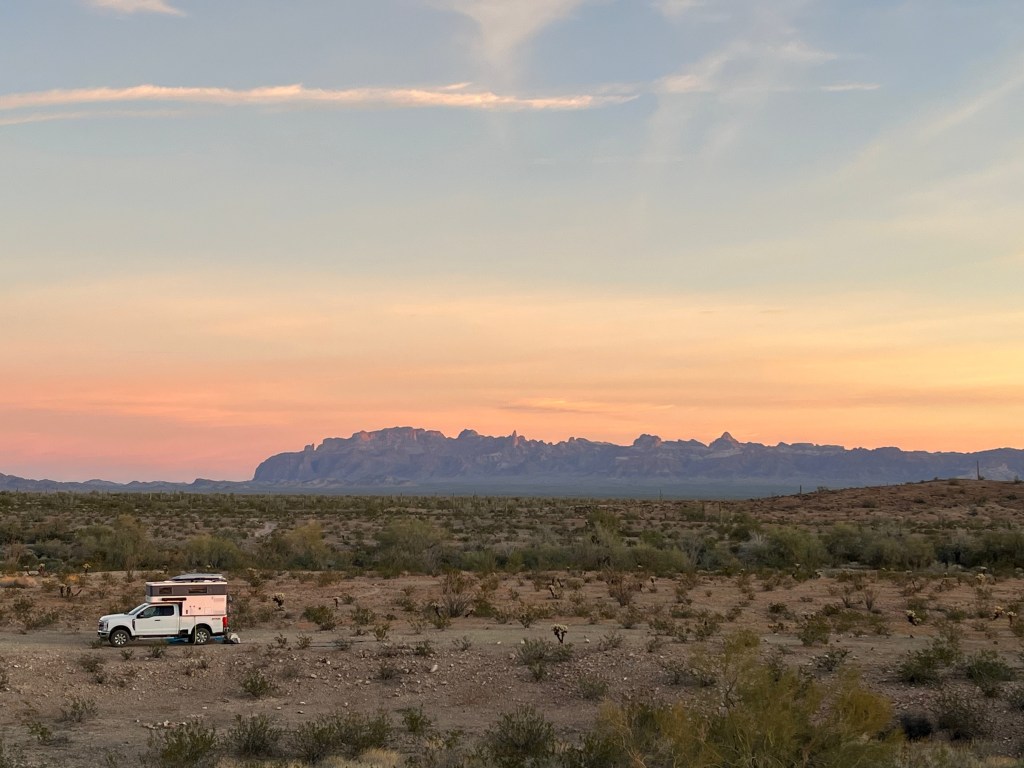
    Once back to the truck, we headed back to the highway and a short bit South to King Road where we turned off and headed deeper into the Kofa Wilderness looking for our home for week. After an hour or so on sometimes sandy, sometimes rocky two track and a few wash crossings, we found a beautiful spot tucked up against some hills to the West and with beautiful views across the desert plain to Signal Peak to the North. To the South, a lush dry creek bed that probably wasn’t dry too long ago judging by the volume of vegetation. Yellow Brittlebush, Pink Ferry Duster, and Desert Lavender, fragrant and alive with honeybees and hummingbirds. We set up camp and settled into our temporary home. We had the place mostly to ourselves all week aside from a few groups of side-by-sides and Jeeps that passed through on the road. As seems to be the norm here in the desert Southwest, the sunrises and sunsets were spectacular every day. Sunrises punctuated by a chorus of birdsong. The weather was mostly perfect with warm temperatures during the day and cool nights. The one exception were some substantial wind gusts that kicked up on our last two nights.

    On our second day I climbed up the little rocky hill to our South after work. The red rock I scrambled up was run through with crystalline veins. The view from the top was of a desert plain extending to Signal Peak with Saguaros reaching up at regular intervals with leggy Ocotillo, squat Creosote bushes, and thorny Palo Verde trees in between. On top there were Prickly Pear cactus in bloom with their huge, showy, hot pink flowers. Such a contrast to the rest of the landscape. Another evening, we rode our bikes further up the road to “Figueroa Tank”. This consisted of a catch pool built in a wash with a shad structure over the top to prevent evaporation. These “tanks” are built strategically within the Refuge by the Department of Fish and Wildlife to provide water for the Bighorn Sheep and other wildlife. On our last night we build a little campfire out of some old 2x4s someone had left using the substantial existing fire ring. We drank some hot chocolate and talked under the mixture of fire and moonlight.

    Kofa is a beautiful place and despite it’s proximity to the Quartzite and all the activity there, it’s not too hard to get off the beaten path and find solitude if you’re willing and able to brave some rougher roads. I think I’ll definitely be heading back here some day.

  • Joshua Tree

    Joshua Tree

    We spent our second week on the road in the Joshua Tree area visiting an old friend. The last time we were here was almost exactly 21 years ago on a college Spring break trip. At that time she had just purchased the property she still lives on and it was basically a raw piece of desert with a one room cabin on it. Over the intervening decades she has turned it into a beautiful homestead oasis with vegetable gardens and even a campsite with power and shower facilities for visitors like us. The plum trees were in full bloom and abuzz with honey bees.

    After taking a couple hours to settle in, we headed out for a hike in the surrounding desert wilds of the Pioneertown Mountains Preserve. We saw the first running water we’d seen in a couple weeks and a few small waterfalls. This is a shortlived and special thing in this dry terrain and we stopped often to relish it with our desert dwelling friends. The hike took us to the top of a peak with beautiful 360 degree views. On the way down, we got another spectacular desert sunset.

    Our first couple of days were quite nice, but then the weather took a turn and got windy and then cool, cloudy, and rainy. I glanced at the weather in Portland on one of those cloudy, rainy days and to my surprise it was sunny and warm! We’d come to the desert to escape the clouds and rain, but it seemed we’d brought it with us and sent the sun North.

    However, the weather was just an excuse to spend plenty of time in our friend’s cozy house, next to the fire, sipping tea or my new favorite beverage she introduced us to of warm goat milk and maple syrup. The milk procured fresh from a farmer friend of hers down the road. We spent hours sharing stories, and catching up on the last 20 years. It’s striking how we’re completely different people than we were then, but that the connection that brought us together all those years ago was as strong as ever.

    In a little break in the weather on a Friday afternoon, we got a chance to help with some garden chores and to take another little hike. The sky was moody and dark, but we saw a rainbow and the temperature was fine for hiking.

    Our final day here, we got a little break in the weather and we headed to the Joshua Tree Farmer’s Market. Our friend is a regular here and is on a first name basis with most of the vendors. It was great to have this local connection and to get to meet so many interesting folks. We filled our food stores with fresh yogurt, hummus, sweet peppers, tomatoes, salad greens, and fruit. The weather turned wet again in the afternoon, which scuttled our plans for another hike, but we made the best of it with a walk in the desert around our friends place in the late afternoon where we still got to see another epic sunset.

    We headed out first thing in the morning headed toward Southern Arizona and the Kofa Wildlife Refuge. At our friend’s suggestion, we decided to drive through Joshua Tree National Park on the way instead of taking the more direct, but much less scenic route. To our surprise, there wasn’t much traffic to speak of and not even a line at the gate. We drove through the Joshua Tree forests and stunning rock formations taking a few breaks to do a little scrambling on the rocks and to walk through the Cholla Cactus Garden.

    Joshua Tree is a beautiful place despite the sometimes unpredictable weather this time of year. I’m thankful to have been able to spend some time here and to reconnect and rekindle and old friendship.

  • Portland to Anza Borrego

    Portland to Anza Borrego

    In this post, I’ll be recapping our first 10 days on the road. It has so far been what we were hoping and planning for these last few, cold dark, winter months in Portland. It hasn’t been all sunshine and palm trees, but the rewards have exceeded the challenges so far.

    We started out from Portland on a cold, rainy, leap day, February 29th, rdestination somewhere in California. It rained pretty much the entire way through Oregon down the I5 with some snow flurries at the higher elevations. We were lucky though because had we left a day or two later, the Siskiyou pass between Oregon and California would have been closed due to a major storm that came through the area dumping feet of snow in some places. For us though, pretty much as soon as we crossed the border, the rain stopped and the sun came out. Welcome to California.

    Our goal was to drive until it got dark and that took us to Chico. It was a bit off of the freeway and a slight detour, but we drove by the turn for Lassen National Park, which we had never heard of and wouldn’t have learned about had we not taken this little road less traveled. Chico also happens to be the only place in the world where you can get a Bun Burger. And, Bun Burger happens to be right across the street from the YoYo museum, which was unfortunately closed.

    From Chico, we made our way to Escondido where we had camping reservations at Dixon Lake Park. We drove through the endless almond orchards and farms of the Central Valley and sat for at least an hour in the infamous LA traffic. When we arrived a bit after dark into Escondido we were a little worried because it didn’t seem to be getting any less suburban as we got closer to the park. However, the park is up over a little hill from the main thoroughfare and once you are in it, it’s fairly secluded and quiet with nice scenery. There was a very nice ranger who met us there, gave us our paperwork, and directions to our campsite.

    We woke up to rain at Dixon Lake. We made coffee and had granola with yogurt in the camper. We were meeting up with some family in San Marcos, which is only a few miles away, so no choice but to put the top down wet and dry it out later. We had a nice visit with family including lunch at Tip Top Meats in Carlsbad, which had an amazing Reuben, and a quick jaunt to the beach. We spent our second night at Dixon Lake, which included more rain, and then headed toward Anza Borrego State Desert Park on Sunday 3/3.

    We headed up and over the mountains on Highway 76. The weather continued to be wet and it actually kind of reminded me of the mountains of Costa Rica a bit. Very tropical feeling. Palm trees and citrus orchards all around. Things started drying out as we dropped down into the town of Borrego Springs. Borrego Springs is a small desert community with a couple gas stations, some hotels, a grocery store. It’s real claim to fame though are the giant metal statues all around the outskirts. There are elephants, cats, giant sloths, a huge scorpion, and the best of all, a dragon. Among many other things. We topped up our gas tank, spent some time looking at the statues, and then headed out to find where would stay for the week. From prior research we had set our sites on the Fish Creek Wash area of the park.

    We drove in a couple hours with a stop at the Wind Caves for a hike. The name is a bit of a misnomer. The “caves” are really just some interesting rock formations. Still worth the short hike though. There are some very nice views of the wash and the surrounding landscape from the trail.

    We settled on a site a few miles from the trail next to a Smoke Tree, with great mountain views and a Desert Lily in close proximity. We visited that Lily every day and on one occasion Jocelyn saw a hummingbird fully immersed in one of the flowers. The wildflower bloom was just getting into full swing with Desert Sunflower, Desert Chicory, Browneyes, and Desert Sand Verbena.

    Our very first night we had our first experience of the Desert Wind. Sometime in the middle of the night, the wind picked up and started shaking the whole truck. It was loud and intense. The weather app said we were getting 40 mile per hour gusts. Luckily I remembered I had packed earplugs for just this situation as well as noisy neighbors if we ended up in a campground. They really made all the difference and we were able to get some pretty good sleep with those installed.

    Over the rest of the week, we settled into our little slice of the desert. We were really out there, with only a handful of 4x4s and a couple of guys on bikes going by the whole week. We woke with the sun, watched the sunrise over the hills, made our food, worked, took short walks and little bike rides in the surrounding hills and washes, and closed out each night with stargazing. This is an official “Dark Sky Park” and the night sky really is spectacular with clear views of the Milky Way. On Thursday night we actually got a soaking rain that made puddles in our awning and everything. For a place that only gets six inches of rain a year, it had to be a pretty big part of that total. The smell after the rain here is hard to describe. Earthy and pungent, like the soil is waking up and coming to life. We noticed a new flower after the rain, a legume we identified as Salton Milkvetch.

    We both work for great companies that have 36 hour weeks, so Fridays are half days. We took the afternoon to explore further up one of the washes we had gone a ways on previously. It started out in more open desert and then slowly narrowed into a canyon of vertical, rippling sandstone. In nooks and crannies there were pockets of a magnificent purple Aster and the little white Browneyes. It seems like the canyon would keep going forever, but it did eventually come to an end after about 3 miles. We had some fun hollering and listening to our voices echo off the canyon walls before heading back the way we came.

    We broke camp on Saturday, my birthday, and headed a bit further down Fish Creek wash to a place called Sandstone Canyon for a bike ride. As the name implies, this is a steep sandstone canyon with a sandy trail running up it. The trail is wide enough for a vehicle and we did see a few 4x4s going in and out. The sandy bits were slow going on the bikes at points, but so worth it. Being on the bike puts you so much more in the environment. We noticed lizards and bird we probably would have missed in the truck. We saw a new flower, Arizona Lupine and more of the magnificent purple Aster. It was about two miles up the road until it ended and only foot traffic was allowed beyond. We kept going on foot exploring side canyons for a few more miles. There were Desert Lilacs alive with honey bees and hummingbirds and mesquite tucked in shaded corners. We headed back the way we came, got back in the truck and drove back out Fish Creek Wash to civilization.

    We headed up and out of the desert and into the mountains to the little town of Julian where we had reserved a room for the night. The temperature dropped quickly and by the time we stopped, the shorts, t-shirt, and sandles I was wearing were definitely the wrong attire. After long, hot showers, we headed across the street for a cheeseburger; A great end to a great birthday. The next morning, we headed to the Julian Cafe and Bakery where I indulged in their famous apple pie with melted cheddar cheese on top for breakfast. From there we are headed to Joshua Tree where we’ll be spending the week with an old friend.

  • And so it begins…

    And so it begins…

    Welcome to the Crooked Trail! To begin with, this blog will document a 10 week journey from Portland, OR through the Southwestern U.S., culminating with the total solar eclipse on April 8th in Wimberley, Texas. We’ll take roughly one month getting there and another month getting back. We depart 2/29/24 and return 5/11/24.

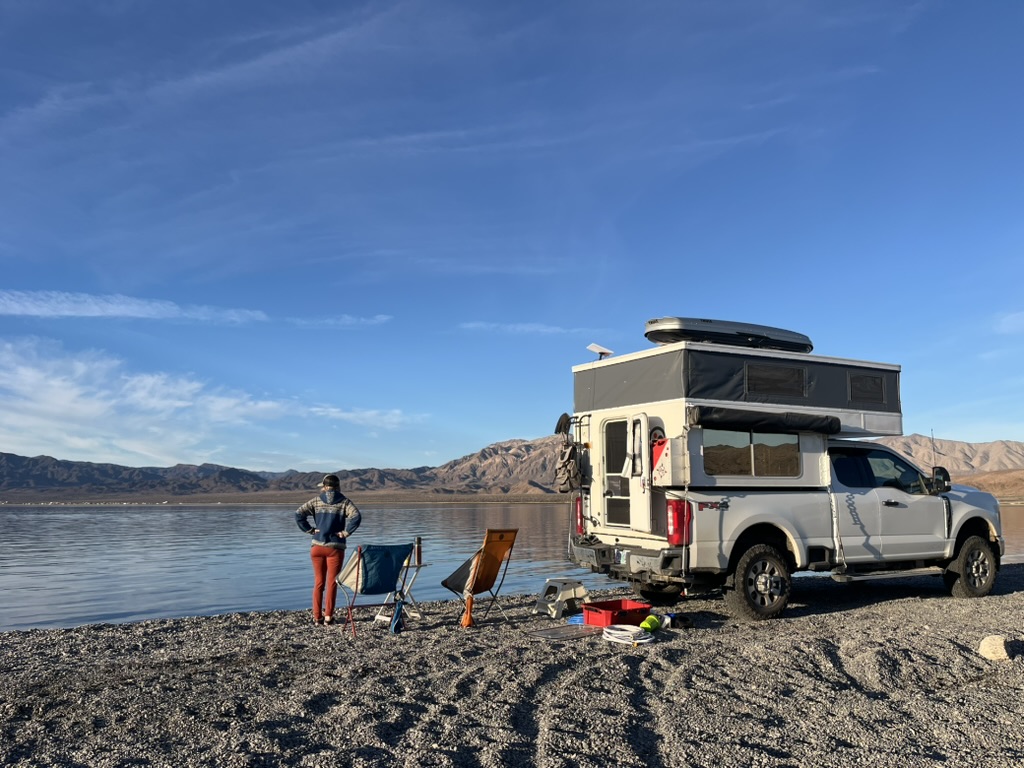
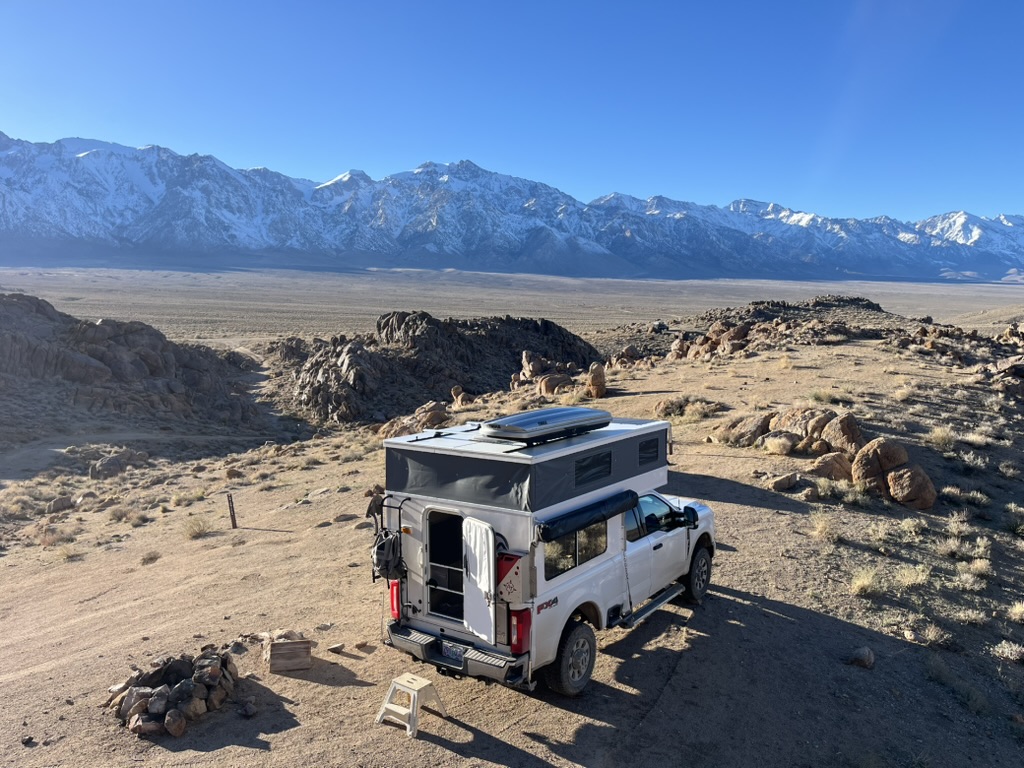
    We are lucky enough to have jobs that allow us to work remotely and with the miracle of Starlink, we can work from the most remote locations. We’ll be taking it slow staying in one location for a week or more while we work and explore. My winter project has been building out the bed of our 2015 F-150 with a Go Fast Camper for full time living and working. I’ll do a future post on the build.

    We’re keeping the itinerary somewhat loose, but our first stop is Escondido, CA and then Joshua Tree for our first week of work. Other places we’ll be spending time are Anza Borrego, KOFA Wildlife Refuge, Tuscon area, Big Bend, Southeastern New Mexico, and Southern Utah.

    We have our house sitter lined up and the truck packed. Let the adventure begin!

    “May your trails be crooked, winding, lonesome, dangerous, leading to the most amazing view. May your mountains rise into and above the clouds. May your rivers flow without end, meandering through pastoral valleys tinkling with bells, past temples and castles and poets towers into a dark primeval forest where tigers belch and monkeys howl, through miasmal and mysterious swamps and down into a desert of red rock, blue mesas, domes and pinnacles and grottos of endless stone, and down again into a deep vast ancient unknown chasm where bars of sunlight blaze on profiled cliffs, where deer walk across the white sand beaches, where storms come and go as lightning clangs upon the high crags, where something strange and more beautiful and more full of wonder than your deepest dreams waits for you — beyond that next turning of the canyon walls.”

    Edward Abbey